
Metamaterials are applied in medicine as well as in other industries, such as automotive or aerospace. The scope of research includes numerical modelling and experimental analysis of metamaterials produced using 3D printing of titanium alloys, focusing on their mechanical properties and potential biomedical applications.
– We design them to have specific stiffness and strength, needed, for example, to work in harmony with bone tissue -explains Michał Doroszko, PhD, Eng. from the Department of Mechanics and Applied Informatics, Faculty of Mechanical Engineering at Bialystok University of Technology. He studies a new class of materials whose properties depend on shape rather than just chemical composition.
A key aspect of the research is the ability to adjust the material stiffness to match that of human bone, which is critical for implants that should integrate with bone rather than act as a foreign element.
– 3D printing technology plays a crucial role in our research. Additive manufacturing, building metal parts layer by layer, enabled the development and study of this type of metamaterials -says Doroszko, PhD, Eng. – We use the LPBF (Laser Powder Bed Fusion) technology, which allows precise 3D printing of metallic elements.
The tested materials have non-continuous structures with voids and designed channels, allowing bone tissue to grow through the material, leading to long-term integration of the implant with bone. The research focuses on the material itself rather than finished medical implants.
Unlike solid materials, metamaterials exhibit properties determined not only by chemical composition but primarily by structural architecture.
– The next step is to determine fracture criteria -adds Doroszko, PhD, Eng. -We analyse the entire process from initial deformation to failure. This allows us to define safe operating limits, which is crucial for potential human use.
Metamaterials have an excellent strength-to-weight ratio, making them attractive wherever lightness and durability are critical.
– Metamaterials are still a new class of materials that require in-depth analysis -explains the Bialystok University of Technology project leader. -Many factors affecting their behaviour are not yet fully understood. The grant allows us to deepen our knowledge and forms the basis for future work.
Research is conducted using modern equipment at Bialystok University of Technology and Gdańsk University of Technology, including testing machines, micro-CT scanners, and microstructure analysis techniques.
– Combining advanced equipment, modern manufacturing methods, and sophisticated numerical models allows us to conduct high-level research – emphasizes Doroszko, PhD, Eng. -Our experiments follow modern research trends and create extensive publication opportunities. This strengthens the scientific potential of Bialystok University of Technology, and our project is an important part of developing this new class of materials.
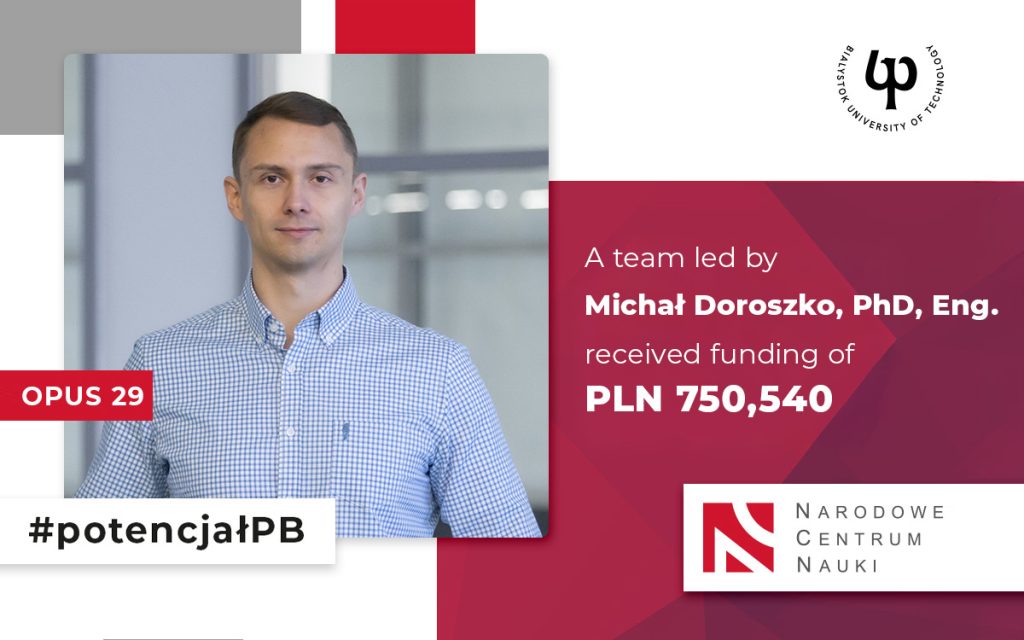
Bialystok University of Technology received PLN 750,540 under the OPUS 29 competition organized by the National Science Centre. The project “Experimental research and numerical modeling of deformation and fracture processes of additively manufactured titanium metamaterials” achieved a very high, third place in OPUS 29 in panel ST8 – process and production engineering. Research is conducted in a consortium led by Gdańsk University of Technology, with Bialystok University of Technology as a partner.
The project leader is Prof. Andrzej Seweryn, DSc, PhD, Eng. from Gdańsk University of Technology. The Bialystok research team includes Michał Doroszko, PhD, Eng. and Anna Falkowska, PhD, Eng. from the Department of Mechanics and Applied Informatics, Faculty of Mechanical Engineering at Bialystok University of Technology. The project also provides for a PhD student or scholarship position to be filled via competition.
The total funding for the project “Experimental research and numerical modeling of deformation and fracture processes of additively manufactured titanium metamaterials” amounts to PLN 1,678,950.
Results of the OPUS 29 competition are available on the website of the National Science Centre.
Prepared by Katarzyna Kozioł