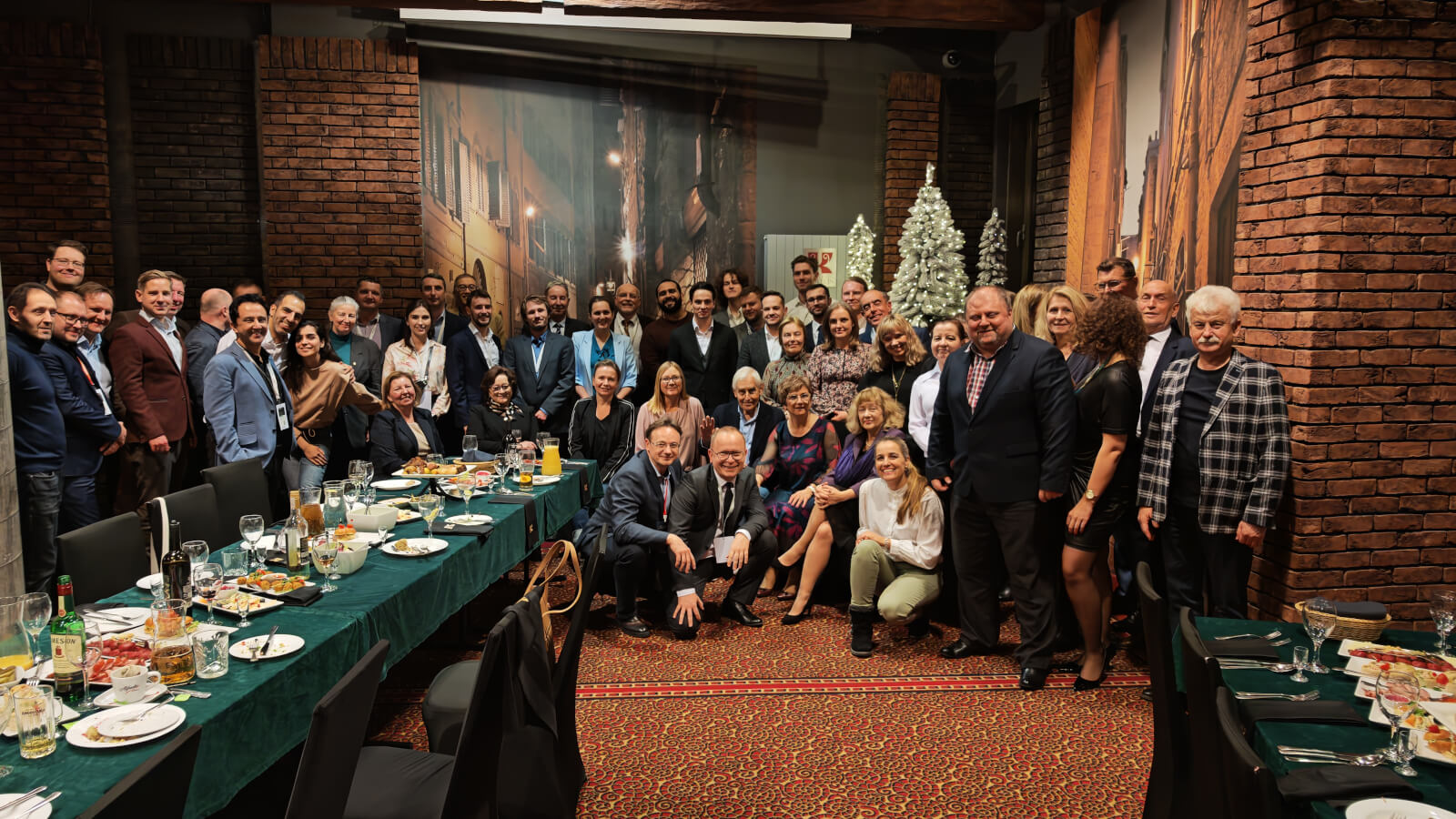
Summary of the AMCM 2025 International Conference
The International Conference “Analytical Models and New Concepts in Concrete and Masonry Structures” (AMCM 2025) was held on 3–5 December 2025 in Auditorium C of the Faculty of Civil Engineering and Environmental Sciences at Bialystok University of Technology, 45E Wiejska Street, Białystok. It was the eleventh edition of this triennial event, first organized in 1993 at Bialystok University of Technology, so after 32 years the conference “came full circle” by returning to its original venue. The conference was organized by the Faculty of Civil Engineering and Environmental Sciences of Bialystok University of Technology in cooperation with the Białystok Branch of the Polish Association of Civil Engineers and Technicians (PZITB) and the Section for Concrete Structures of the Civil and Water Engineering Committee of the Polish Academy of Sciences (PAN). Honorary patronage was provided by the Minister of Infrastructure, the Marshal of the Podlaskie Voivodeship and the Mayor of the City of Białystok, while national patronage was taken by the Voivode of Podlaskie, Jacek Brzozowski, the Rector of Bialystok University of Technology, Assoc. Prof. Marta Kosior‑Kazberuk, PZITB, the Polish Chamber of Civil Engineers and the Polish Academy of Sciences. International patronage was granted by RILEM, fib (International Federation for Structural Concrete) and ACI (American Concrete Institute), and the conference partners included: the Podlaskie Voivodeship, the City of Białystok, Astra Technologia Betonu, Schöck, PPP IdeaPro and PP Nordica Polska.
AMCM 2025 brought together nearly 100 participants from 11 countries, including the United States, Canada, Brazil, India, China, the Czech Republic, Spain, Germany, Israel, Portugal and Poland. Over the three days, a total of 43 papers were presented.
The Scientific Committee was chaired by Assoc. Prof. Marta Kosior‑Kazberuk, PhD Eng., Rector of Bialystok University of Technology. The Vice‑Chairs were Prof. Michał Bołtryk, Dean of the Faculty of Civil Engineering and Environmental Sciences, and Prof. Wit Derkowski, Chair of the Section for Concrete Structures of the Civil and Water Engineering Committee of the Polish Academy of Sciences.
The conference served as a forum for exchanging scientific and research experience in the field of reinforced concrete, concrete and masonry structures. The main topics covered concrete and innovative materials, structural properties and design, construction methods and management, outstanding structures, masonry structures, composite structures and innovative composite materials, dynamic diagnostics of structures, prefabricated structures and materials, sustainable development and special structures.
The programme included three plenary sessions with keynote lectures by invited experts. Prof. Jan Bień (Wrocław University of Science and Technology) delivered a keynote lecture entitled “Technical Gerontology of Concrete Bridges”. Prof. Agnieszka Bigaj‑van Vliet (Netherlands Organisation for Applied Scientific Research, member of the fib Presidium) discussed the role of the International Federation for Structural Concrete and Model Code 2020 in enabling innovation in concrete structures, stressing that one of the key aims of AMCM is to confront theory with the practical needs of industry and that science must underpin industrial development, particularly in areas such as decarbonisation, automation of production, new computational techniques and advanced methods of analysis.
One of the dominant themes of AMCM 2025 was the circular economy in construction. Prof. Wit Derkowski (Cracow University of Technology), Chair of the Section for Concrete Structures of the Civil and Water Engineering Committee of PAN, emphasized the need to design structures for disassembly and reuse, for adaptability to changing conditions and for zero‑emission performance. He also pointed to the challenge of strengthening cooperation between academia and industry, which is crucial for transferring innovations into construction practice. Researchers from Bialystok University of Technology presented their achievements related to elements with non‑metallic reinforcement intended to replace conventional steel and thus reduce the CO₂ footprint of construction. The university is also actively conducting work on concrete recycling and holds patent applications in this area. Flagship circular‑economy projects are being implemented at Bialystok University of Technology in which decommissioned wind turbine blades are transformed into innovative acoustic barriers for road infrastructure.
The conference also showcased the contribution of researchers to the protection of cultural heritage, including studies and conservation work in the 16th‑century monastic catacombs in Supraśl (a Polish History Monument since 2023) and a repair technology for the vaults of the Białystok Archcathedral developed, among others, by Prof. Czesław Miedziałowski and Rector Prof. Marta Kosior‑Kazberuk. The main lecture on this topic, “Key Issues in the Conservation of Historic Masonry Structures. Case Studies from Spain”, was given by Prof. María Aurora Flórez de la Colina from Universidad Politécnica de Madrid.
The three‑day programme comprised: December 3, 2025 (Wednesday) – registration, official opening, Plenary Session I, Sessions I–II; December 4, 2025 (Thursday) – Plenary Session II, participation in the Bialystok University of Technology Anniversary Celebration, parallel Sessions III–V, and the gala dinner; December 5, 2025 (Friday) – Plenary Session III, Session VI, closing and summary, lunch and a departure for a study visit to Vilnius. After the official closing, some participants took part in a study visit to Vilnius Gediminas Technical University, which included a tour of the university and of Vilnius on 6 December 2025.
Assoc. Prof. Mirosław Broniewicz, PhD Eng., conference chair and head of the AMCM 2025 Organizing Committee, underlined that the importance of the conference could hardly be overstated, as it brought together leading scientists and provided substantial benefits, especially for young researchers by supporting their professional development and the exchange of ideas and experience. Assoc. Prof. Jolanta Prusiel, PhD Eng., from the Department of Building Structures and Structural Mechanics at Bialystok University of Technology, highlighted that the conference was an excellent platform for exchanging ideas, particularly for early‑career researchers building their careers at the university. The AMCM conference has a tradition of more than 30 years: the first edition was held in 1993 at Bialystok University of Technology, and subsequent meetings took place every three years at different academic centres in Łódź (1996, 2008), Wrocław (1999, 2014), Kraków (2002, 2011), Gliwice (2005, 2017) and Lublin (2020). Returning to Białystok after more than three decades had a symbolic dimension, as the conference came back to the place where the idea of analytical models for concrete structures was born.
The three‑day conference concluded with the preparation of a monograph containing all abstracts, while selected contributions will be published in high‑quality, peer‑reviewed journals such as Archives of Civil Engineering, Materiały Budowlane and Ekonomia i Środowisko (Environment and Economics). These journals are indexed and highly ranked in the Polish evaluation system.
The AMCM 2025 programme also included clearly defined social and accompanying events. These comprised a welcome dinner on the first day (3 December), a gala dinner on the second day (4 December) as the main social event of the conference, and participation in the official Bialystok University of Technology Anniversary Celebration at midday on 4 December, which combined academic and integrative elements. The accompanying events had a distinctly integrative and networking character, focused on a calm, professional atmosphere and on building international relationships. A study visit to Vilnius rounded off the event, including travel, a regional dinner in Lithuania, a visit to Vilnius University on the following day, sightseeing in Vilnius and a joint lunch, and was treated as an extended social‑and‑study component of the conference.
Conference partners and sponsors such as Astra Technologia Betonu, Schöck, PPP IdeaPro and PP Nordica presented their products and solutions at exhibition stands. In participants’ feedback and organizers’ comments, AMCM 2025 was highly rated, particularly by young researchers, who appreciated the opportunity for informal exchange of ideas and the development of professional networks; the social events were therefore seen as an essential complement to the scientific programme rather than as isolated banquets.
The main AMCM 2025 sessions were structured into thematic blocks in the area of concrete and masonry structures. The key thematic “umbrellas” were:
- Concrete and Innovative Materials – concrete materials, concrete under complex stress states, HPC, design of durable and sustainable concretes, low‑emission materials, recycling and circularity in construction, methods for testing and assessing structures.
- Structural Performance and Design – advanced design methods, numerical modelling, analytical models in line with new codes (e.g. fib Model Code 2020), dynamic analysis, structural health monitoring, durability and life‑cycle assessment.
- Construction Methods and Management – prefabrication and prestressing, BIM, construction process management systems, new construction techniques, digitalization of the construction process, assessment of existing structures.
- Outstanding Structures – modelling and design of bridges, tunnels, offshore structures, nuclear facilities, foundations and other special structures with elevated safety and reliability requirements.
- Masonry Structures – design and assessment of masonry structures (including historic ones), modelling of masonry and mortars, degradation and ageing, probabilistic models of masonry deterioration.
- Composite Structures and Innovative Composite Materials – FRP, composite strengthening and reinforcement, new composite materials, modelling of composite structures, FRP strengthening standards.
- Dynamic Diagnostics of Structures – vibrations, seismic analysis, effects of vibrations on structures and users, modal identification, vibration‑based monitoring, vibration control and isolation.
- Prefabricated Structures and Materials – issues related to the design and operation of precast structures and materials for prefabrication.
- Sustainable Development / Circularity in Construction – sustainable design, reduction of the carbon footprint, circular economy in construction, materials for energy‑efficient buildings.
At AMCM 2025 the topic “Concrete and Innovative Materials” was interpreted primarily in terms of sustainable, low‑emission and advanced concretes and reinforcement systems. Examples of innovative material groups within this theme included high‑performance and high‑durability concretes with optimized mix designs, mineral admixtures and improved resistance to complex stress states, fatigue and long‑term loading; low‑carbon concretes with reduced clinker content and the use of supplementary cementitious materials such as fly ash, slag and other by‑products, designed to minimize CO₂ emissions and enhance circularity; concretes with recycled aggregates supporting the development of cement‑based composites incorporating recycled concrete; non‑metallic (composite) reinforcement systems with FRP bars, fibres and micro‑rebars as longitudinal or dispersed reinforcement; and materials dedicated to energy‑efficient buildings and renovation, including concretes and mortars tailored to thermal upgrading and refurbishment, compatible with insulation materials and durable in ETICS‑type systems.
Innovations in numerical modelling focused mainly on more advanced material models, alignment with new codes and the integration of AI/ML. These developments can be grouped as follows:
- Advanced numerical models for concrete and masonry structures – including FEM models for concrete (cracking, crushing, creep, rheology), masonry and composite structures, with particular attention to material non‑linearity and cracked‑section behaviour.
- Code‑compliant models and Model Code‑based approaches – in the “Models for concrete structures analysis according to new Codes” sessions, analytical approaches consistent with the latest standards and fib Model Code 2020 were discussed, covering load‑bearing capacity, cracking, reliability and serviceability‑limit‑state analysis.
- Deep learning and AI in structural engineering – the “Deep learning for structural engineering” strand within “Structural Performance and Design” addressed the use of neural networks for predicting structural response, damage detection, model‑order reduction and acceleration of nonlinear analyses.
- Non‑deterministic and probabilistic models for structural health monitoring – “Non‑Deterministic models for structural health monitoring” explored probabilistic and stochastic approaches to modelling structures and assessing their condition based on measurement data (vibrations, deflections, long‑term monitoring).
- Life‑cycle and durability modelling – “Life‑Cycle performance assessment of civil engineering systems” covered numerical models linking structural mechanics with degradation processes (carbonation, reinforcement corrosion, fatigue) and LCA/LCC‑based life‑cycle evaluation.
Discussions at AMCM 2025 emphasized several key challenges currently faced by the construction sector, particularly in relation to concrete and masonry structures:
- Decarbonisation and carbon footprint – the need to accelerate emissions reductions through new materials (low‑carbon concretes) and optimized design across the entire life cycle of structures.
- Circular economy – as highlighted by Prof. Wit Derkowski, construction still has “backlog” in circular‑economy implementation, including design for disassembly, reuse of elements, concrete and aggregate recycling and waste minimization on construction sites.
- Automation and digitalization of production and construction – according to speakers including Prof. Agnieszka Bigaj‑van Vliet, urgent needs include automation of element production, adoption of new computational and analytical techniques and better integration of digital tools in design and execution.
- Bridging the gap between research and practice – one of AMCM’s core missions is to confront theory with the practical needs of industry; a key challenge is to translate advanced numerical models and new materials into simple, user‑friendly guidelines and tools for designers and contractors.
- Depletion of aggregate resources – conference materials listed the depletion of natural aggregates, especially sand, as a pressing challenge, further reinforcing the need for concrete‑recycling technologies and alternative raw materials.
The AMCM 2025 conference in Białystok confirmed the strong position of Polish research centres in global work on modelling and design of concrete and masonry structures. The topics addressed – from innovative materials and dynamic diagnostics to sustainable development – reflected current global trends in the decarbonisation of construction, the development of composites and prefabrication, and the digitalization of design and durability assessment processes. The event aligned with the international agenda on advanced numerical models, structural reliability and the use of high‑durability materials, as promoted by organizations such as fib, RILEM and ACI. The presence of experts from many countries and the high scientific quality of the contributions indicate that the findings presented at AMCM 2025 can feed into global knowledge bases and serve as a reference point for future research on concrete and masonry structures.